Bookshelf

Bookshelf
A mix of titles currently on my shelves.
Showing posts with label wilderness. Show all posts

Monday, September 12, 2022

The Little Bush Plane That Can

In the time-honored picture book tradition of “little engines that can,” Alaskan author Brooke Hartman’s The Littlest Airplane takes readers on a “small but mighty” challenge with a twist: rescuing stranded hikers in the northern wilderness.


Cover of The Littlest Airplane by Brooke Hartman, illustrated by John Joseph. Published by Alaska Northwest Books/West Margin Press, 2022.


Hartman’s story in rhythmic, rhyming verse begins on a runway. First the mighty turboprop airplane displays its virtues, “sturdy and quick.” Next comes the cargo plane, “brawny and long,”


Cargo plane, ready to roll.


followed by the jet plane, “her engines a-blast.” Finally we see the little bush plane off to the side, wondering, “I’m not strong. I’m not speedy. What good can I do?”


Cargo plane, turboprop, and jet plane are bigger and faster than the little bush plane.


Well of course the little bush plane can — and does — do good. When the other planes fail to reach a pair of hikers caught in a snow storm, precisely because they are too big and too fast to land in a small clearing, the Littlest Airplane comes to the rescue.


The little bush plane perseveres through the storm.


If the outcome is predictable to adults, it is nonetheless wholeheartedly satisfying, especially to little readers who are routinely told they aren’t big enough to do things.


What distinguishes this story, in addition to the setting, is the information intriguing to young minds interested in “things that go.” Take for instance this description of the little bush plane’s landing approach: “His strut-mounted wings gave him excellent sight./His speed? Not too fast. His propeller? Just right.” Illustrations by John Joseph capture the personalities of the planes while adhering to mechanical details, as well as conveying the feelings of speed and motion. 
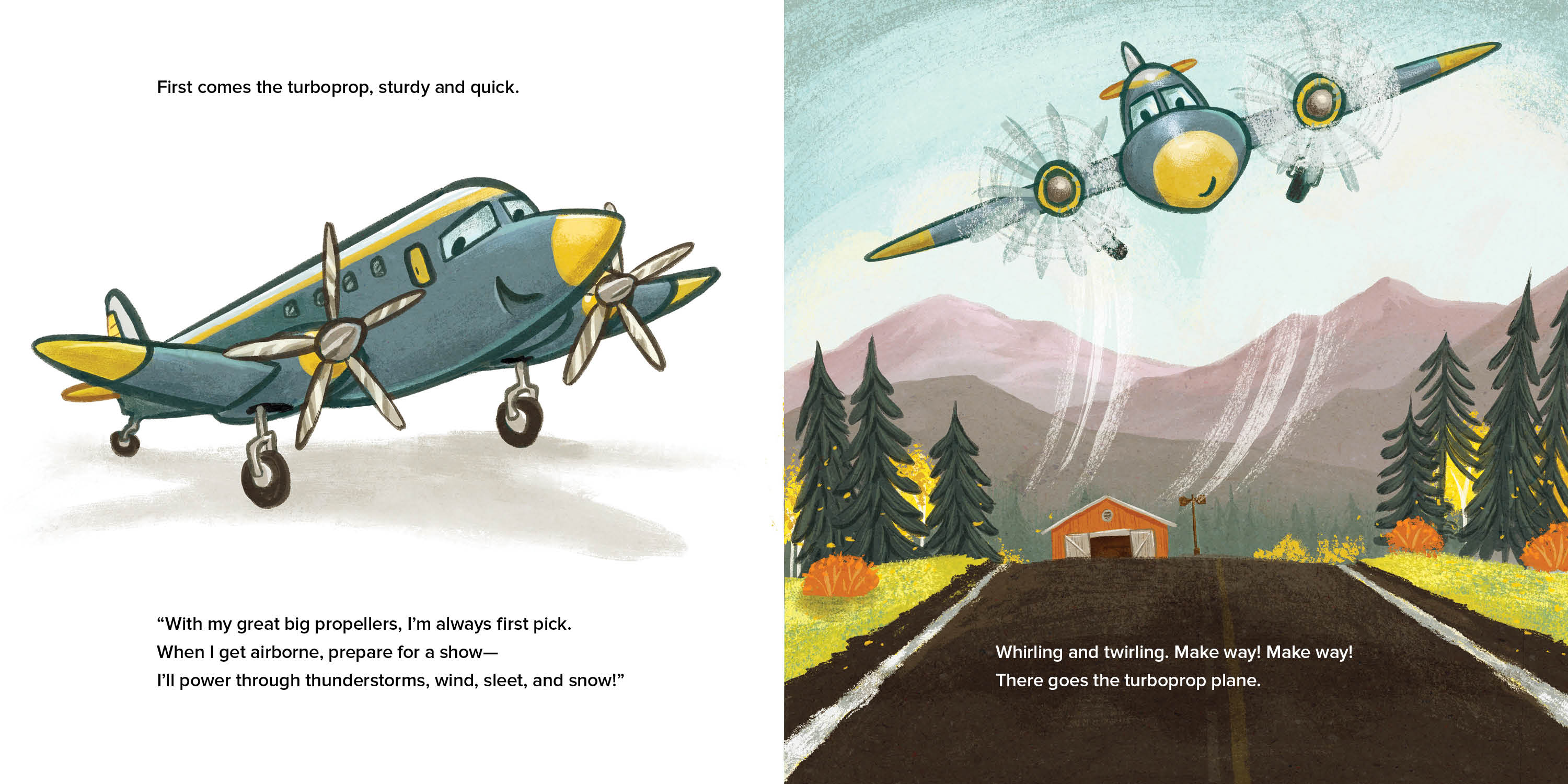

Turboprop has big propellers to power through weather.


Endpapers extend the story by setting the wilderness scene with just a hint of the drama to come, and at the end, returning quietly to wilderness. Final pages include an illustrated guide to “Parts of a Bush Plane,” as well as a note with further information about bush planes.


I can't resist adding that my two-year-old grandson loves this book. He insists that we return repeatedly to the pages that feature all four airplanes so he can compare and identify them. He enjoys trying out interesting terms like “turboprop” and “propeller” and "cargo plane." Discussions of wing placement and wheels have given rise to explanations of landing on the ground with wheels and on water with floats. He now searches airplanes overhead for evidence of wheels vrs. pontoons. Perhaps the Littlest Airplane will venture onto the water next? I know one little boy who would be thrilled!

Monday, July 4, 2016

An Almost-True Alaskan Adventure


A recent picture book by Erin McKittrick and illustrator Valise Higman, My Coyote Nose and Ptarmigan Toes, melds nature and imagination in a child’s-eye view of a family’s outdoor adventures.

McKittrick, who has authored three books for adults, was inspired to write her first picture book while on a family expedition. Her son coped with the rigors of an unexpected blizzard in an unusual way: he pretended to be a wild, wooly mammoth, impervious to snow and cold. The result is an “almost-true Alaskan adventure” in verse about the joys and challenges of wilderness backpacking, boating, and camping. The young narrator imagines himself as numerous wild animals — the coyote and ptarmigan of the title, as well as a beaver, sparrow, bear, mountain goat, and others — each suitable for adapting to a specific challenge on the family’s journey.

Published by Little Bigfoot/Sasquatch Books, 2016

Higman fills black, cut-paper silhouettes with colored paper and paint to create bright, bold illustrations with texture, depth, and definition. The pictures give a feeling reminiscent of both stained glass and block prints. Each two-page spread throughout the book creates a scene of the family interacting with nature, rich with accurate natural details as well as whimsey, as the boy “becomes” a new creature.

Rhythm and rhyme generally flow smoothly, although inconsistencies in the pattern of the verse and number of lines sometimes contribute to confusion as the transition from reality to imagination is occurring. That said, My Coyote Nose and Ptarmigan Toes is a welcome addition to the relatively small number of books that celebrate children and their families interacting with wilderness in ways that are both realistic and imaginative.

As attractive and imaginative as it is informational, the book will be enjoyed by children and families, as well as useful in educational settings. It’s an exuberant reminder how powerful pretend can be and how nature fosters creativity.

For more information about Erin McKittrick, her books, and her family's outdoor adventures, visit her website.

Friday, January 1, 2016

Meanwhile, on Bear Island

Characters in young adult novels are always trying to survive, it seems — everything from bullying to dystopian government to bad romance or a dysfunctional family. Surviving Bear Island, a debut novel by Alaskan Paul Greci, distills that drive to survive down to the “bare” (so sorry!) essentials: a teenage boy struggling to stay alive, all alone, in a harsh and wild environment.

Alaska’s Prince William Sound affords a perfect setting for Greci’s gripping middle-grade tale of teen against the wilderness. While sea kayaking with his father, Tom Parker is stranded on Bear Island after their kayaks overturn in rough water. With only a small emergency kit in his pocket, Tom must rely on himself to survive. The story advances through numerous hardships and challenges — bears and other wild animals, the constant search for food, cold weather, fashioning spears for fishing and building shelters — paced by flashbacks that fill in details of how the accident occurred. 

Surviving Bear Island by Paul Greci
Illustrations by Paul Madden

The story keeps the reader wondering throughout, Could I do that? The cold answer is, Maybe — or not. Tom’s quest for physical survival is difficult at best. Yet often his struggle is inward, as well — to think clearly, to not give up, to keep fear and despair at bay. While the momentum of the plot is always about trying to stay alive and find his dad, much of the emotional development comes through Tom’s thoughts as he spends weeks alone. Though sadness over the death of his mother and his father’s subsequent lapse into grief and depression sometimes overtake him, Tom ultimately draws strength from their nurture and love.

Greci’s website explains that the author spends a lot of time outdoors and is a veteran sea kayaker, as well as a teacher. These experiences bring a richness of detail about kayaking and wilderness conditions to the story, as well as a first-person narrative voice that rings true.

Surviving Bear Island was chosen as a Junior Literary Guild offering for 2015 in the category of High Interest for grades 5-8. The publisher, Move Books, specializes in middle-grade books for boys. I confess that when I first picked up Surviving Bear Island, I thought “Great boy book.” But don’t be fooled! 


My 11-year-old friend Olivia was riveted by the story, which she read avidly while on a family camping trip. Girls (including me) like adventure and survival stories, too.