Bookshelf

Bookshelf
A mix of titles currently on my shelves.
Showing posts with label Alaska Northwest Books. Show all posts

Monday, September 12, 2022

The Little Bush Plane That Can

In the time-honored picture book tradition of “little engines that can,” Alaskan author Brooke Hartman’s The Littlest Airplane takes readers on a “small but mighty” challenge with a twist: rescuing stranded hikers in the northern wilderness.


Cover of The Littlest Airplane by Brooke Hartman, illustrated by John Joseph. Published by Alaska Northwest Books/West Margin Press, 2022.


Hartman’s story in rhythmic, rhyming verse begins on a runway. First the mighty turboprop airplane displays its virtues, “sturdy and quick.” Next comes the cargo plane, “brawny and long,”


Cargo plane, ready to roll.


followed by the jet plane, “her engines a-blast.” Finally we see the little bush plane off to the side, wondering, “I’m not strong. I’m not speedy. What good can I do?”


Cargo plane, turboprop, and jet plane are bigger and faster than the little bush plane.


Well of course the little bush plane can — and does — do good. When the other planes fail to reach a pair of hikers caught in a snow storm, precisely because they are too big and too fast to land in a small clearing, the Littlest Airplane comes to the rescue.


The little bush plane perseveres through the storm.


If the outcome is predictable to adults, it is nonetheless wholeheartedly satisfying, especially to little readers who are routinely told they aren’t big enough to do things.


What distinguishes this story, in addition to the setting, is the information intriguing to young minds interested in “things that go.” Take for instance this description of the little bush plane’s landing approach: “His strut-mounted wings gave him excellent sight./His speed? Not too fast. His propeller? Just right.” Illustrations by John Joseph capture the personalities of the planes while adhering to mechanical details, as well as conveying the feelings of speed and motion. 
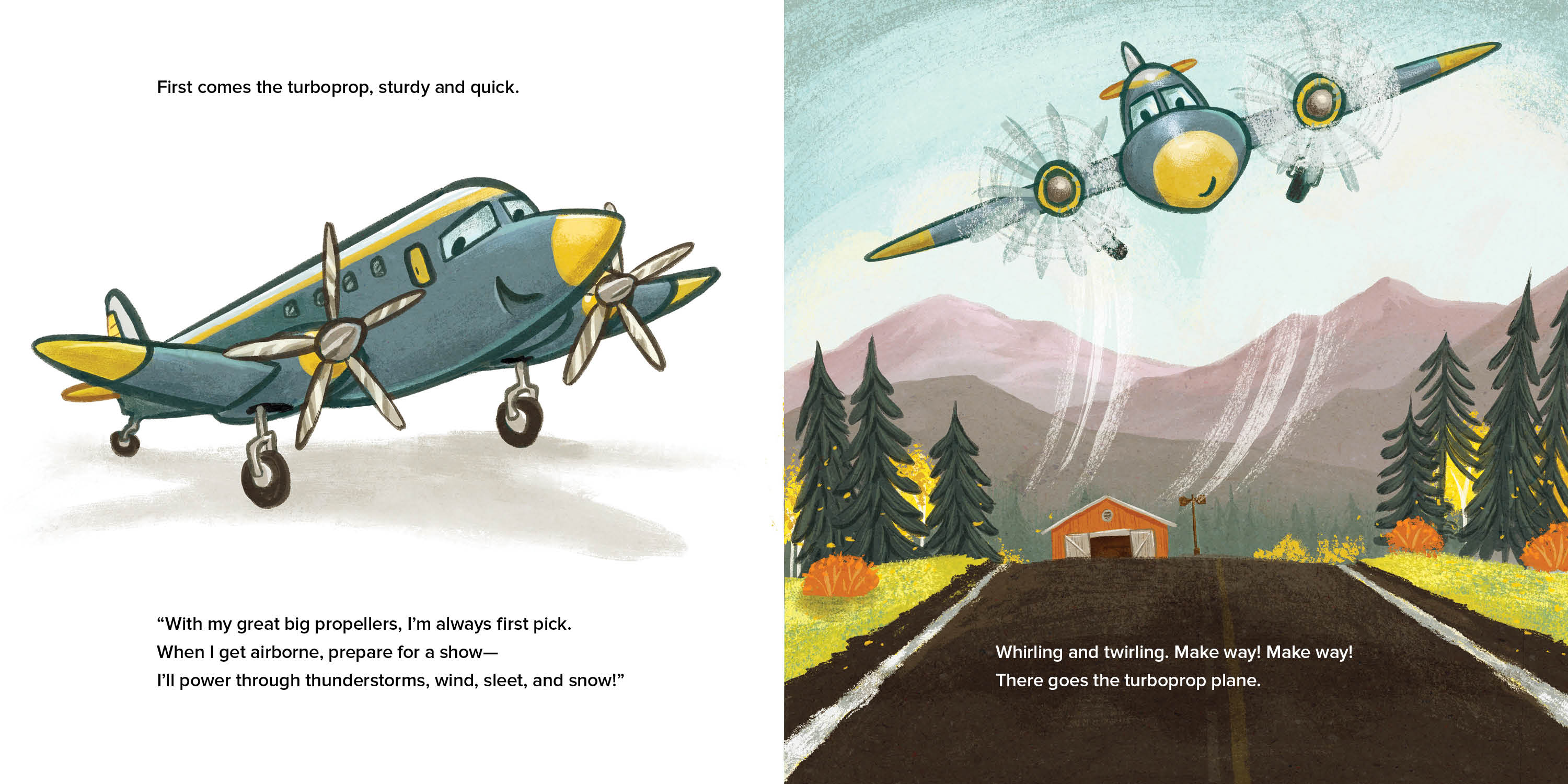

Turboprop has big propellers to power through weather.


Endpapers extend the story by setting the wilderness scene with just a hint of the drama to come, and at the end, returning quietly to wilderness. Final pages include an illustrated guide to “Parts of a Bush Plane,” as well as a note with further information about bush planes.


I can't resist adding that my two-year-old grandson loves this book. He insists that we return repeatedly to the pages that feature all four airplanes so he can compare and identify them. He enjoys trying out interesting terms like “turboprop” and “propeller” and "cargo plane." Discussions of wing placement and wheels have given rise to explanations of landing on the ground with wheels and on water with floats. He now searches airplanes overhead for evidence of wheels vrs. pontoons. Perhaps the Littlest Airplane will venture onto the water next? I know one little boy who would be thrilled!

Tuesday, November 19, 2019

Finding Gold

Matthew Lasley’s first picture book is Pedro’s Pan: A Gold Rush Story, illustrated by Jacob Souva and published by Alaska Northwest Books in 2019. This whimsical tale manages to tell an entertaining story from the point of view of a gold pan (“call me Pan for short”) while also conveying basic information about prospecting for gold — a topic almost non-existent in children’s picture books.

Pedro's Pan: A Gold Rush Story
by Matthew Lasley, illustrated by Jacob Souva

Above all, Pedro's Pan is fun. Lasley focuses on telling a simple story for ages four to seven about the challenges and joys of a pan and his man in the wilderness. Parents and children may read the story solely for pleasure, while educators may use it as a springboard to spark interest in geology and to explore the social, political, and environmental repercussions surrounding Gold Rush history in Alaska and elsewhere.

Thanks to a well-written text, imaginative illustrations, and thoughtful pacing, the personalities of both Pan and his prospecting partner Pedro come to life as they search for gold. It is Pan, however, that especially shines. In Lasley’s story, Pan is more than a tool; he is a committed partner and companion who helps Pedro in unexpected ways and worries about letting Pedro down.


"On sunny days I shade Pedro's eyes.
On rainy days I keep his head dry."

Lasley smoothly incorporates basic information and vocabulary about prospecting into the story, including quartz, black sand, fool’s gold (iron pyrite), and panning. Pan’s voice is straightforward and engaging, with a touch of humor that both kids and adults can appreciate.

“What is it, Pedro? Do you see
a moose? Is it a bear? Did a
mosquito fly up your nose?"


Souva’s illustrations extend and complement the text with verve. Unlike the time-worn, stodgy historical images of Gold Rush prospectors we’re familiar with, Pedro verges on the cartoonish — in a contemporary, energetic way. True to prospector form, he still wears suspenders, patched jeans, and what I presume is a button-down union suit. But Souva’s style — a mix of what might be called naive with digital sophistication — gives a feeling of bringing the past into today. The red-flannel-patterned endpapers add a fitting touch.

Pedro’s Pan includes a brief note on Felix Pedro, a real-life Italian emigrant and prospector whose discovery initiated a second gold rush and the founding of Fairbanks, Alaska. Lasley also gives directions on “How to Pan for Gold” and “Gold Facts.” From his bio, we learn that Lasley grew up in an Alaskan gold-mining family and currently lives in Anchorage, where he teaches first grade.

Thursday, June 28, 2018

How Did Raven Get That Crooked Nose?

How Raven Got His Crooked Nose: An Alaskan Dena’ina Fable is my new favorite Alaskan picture book. To begin with, it’s a Raven tale, complete with tomfoolery, transformation, and tricksterism. That’s a great start but the best news is that it’s wonderfully told by Barbara and Ethan Atwater, skillfully illustrated by Mindy Dwyer, and thoughtfully designed by the team at Alaska Northwest Books.

How Raven Got His Crooked Nose -- Cover

Put all together, the book’s creators have accomplished no easy task — a modern retelling of a traditional Dena'ina Athabascan tale that honors the story and makes it accessible to children both within and outside of the culture it comes from.

This is a teaching tale, as well as a story-within-a-story. Scenes with a modern-day Dena’ina Grandmother and Granddaughter working at typical subsistence activities (berry picking, harvesting salmon) alternate with the sukdu, or story, of how Raven’s nose became crooked. Artistic style and color palette help clarify the two. Dwyer’s illustrations skillfully weave back and forth between the Raven tale and the contemporary storytelling setting.


Grandmother and Granddaughter with blueberries

Scenes with Grandmother and Granddaughter are portrayed realistically, with a color palette taken from the natural word and art that bleeds to the edges of the page, while Raven’s world is shown with more stylized representation. Dwyer also employs frames to contain the Raven tale within the larger story and uses graphic novel-style techniques. Panels accelerate the sense of action and occasional first-person speech bubbles break the narrative in the same way an oral storyteller may interject as narrator or speak a character’s part.

Where was his nose?

This synthesis of traditional and modern storytelling techniques works well to preserve the tone of the original oral tale, with its back-and-forth between teller and listener — or in this case, reader — and transformational elements, such as when Raven turns into a man, while speaking to readers of the 21st century.

Additionally, the authors skillfully incorporate Dena’ina words into the text, helpfully and unobtrusively including side notes with pronunciation and very brief definitions. Back matter includes a note with information about Alaskan Dena’ina people, their stories, and culture, as well as a brief glossary of Dena’ina words used in the text and a bibliography for further reading.


Chida finds Raven's nose

The tellers of this story, Barbara Jacko Atwater and her son Ethan Jacko Atwater, have a personal connection to it. Her great uncle Walter Johnson, a respected Dena’ina elder, told them the story, among others, with the instruction to “go and tell this story in your own way.” Readers in Alaska and elsewhere can be glad they’ve taken his direction to heart. As they say in their Dedication (or “edication,” since Raven the trickster has playfully flown off with the “D”!) Chin’an, thank you, for sharing this story.

Sunday, May 3, 2015

In Praise of Early Chapter Books

Early chapter books are the overlooked middle children of the kid lit world. While picture books get ooohs and aaahs for their beauty and cleverness, and young adult books get attention for their edginess and quirky characters, beginning chapter books sit quietly on the shelf, ignored — until you need them.

And we do need them. Early chapter books give young readers a story long enough to sink their literary teeth into without overwhelming. They build confidence and a feeling of satisfaction at having read an entire book — a real book, with chapters. One that doesn’t say “beginning reader” on its cover.

Because I love watching kids learn to read — and especially, learn to love to read — I have a soft spot for these slim little books, usually illustrated in black-and-white. The best are simple and yet compelling, with memorable characters, an interesting setting, and enough action to hold their readers’ attention.

Series are popular with young readers. They help children identify a new book they can feel confident they’ll like, based on past experience. The characters are familiar and the format consistent, which adds to that important feeling of mastery — I can do this! Series stories also make it easier to slip into an imagined world, like revisiting a place you enjoy and discovering new delights each time.

The Seldovia Sam books by Susan Woodward Springer stand out as Alaska’s best offering in the early chapter book realm. Oddly enough — or maybe not — also illustrated by Amy Meissner!


Published by Alaska Northwest Books.